

Commentary by: Adonis Hoffman
Tuesday, September 22, 2026
For decades, America has opened its doors wide to Chinese companies. Their products were welcomed into U.S. homes and factories. Chinese technology found its way into U.S. telecommunications systems, drones, port equipment, electronics and medical devices. American corporations –large and small—moved manufacturing and distribution to China, attracted by lower costs and a huge new market.
It was a reasoned calculation based on sound business assumptions. China would gain access to American consumers. American companies would gain greater access to a massive China market. Both nations would prosper through mutual trade, investment, economic cooperation, and healthy competition.
But that has not been the case. In fact, the trade imbalance between China and the United States is so vast that even after a year of the steepest tariffs since the 1930s, America still bought $200 billion more from China than it sold there.
China certainly deserves credit for what it has accomplished. In one generation, it built a manufacturing machine unlike anything the world had seen. Chinese companies learned quickly and competed aggressively. But China also made industrial policy a national priority.
Made in China 2025 was not a slogan. It identified industries that Beijing considered important and directed government resources toward building Chinese strength in them. A 2025 report from the U.S.-China Economic and Security Review Commission found that China met or exceeded many of the ambitious goals it set a decade earlier.
Drones, for example. A Chinese company, DJI, accounts for more than 90 percent of the American commercial drone market, according to the U.S.-China Commission. Its products are used by businesses and public safety agencies across the country, including police departments, and law enforcement agencies throughout American cities and rural counties. Our default to better or cheaper products has created a high-level of dependence on one supplier, which national security experts say is no longer sustainable.
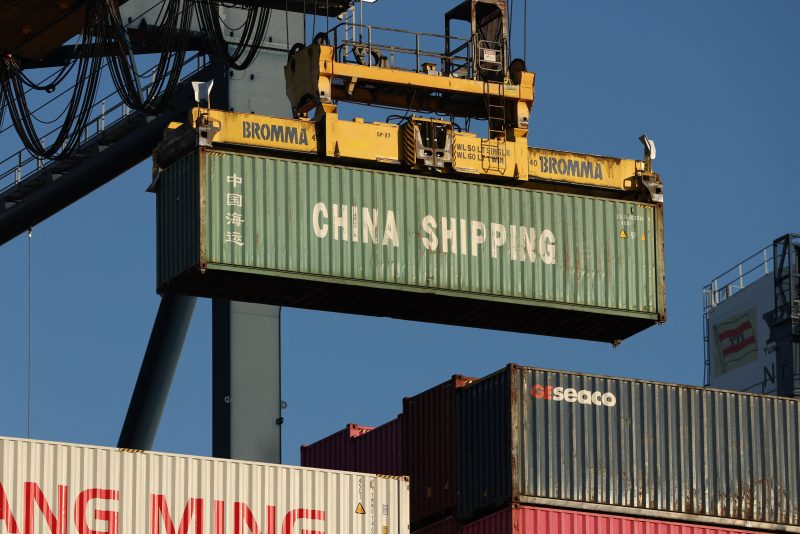
Ports offer an even more striking example. Shanghai Zhenhua Heavy Industries, better known as ZPMC, is a Chinese state-owned company that manufactures roughly 80 percent of the ship-to-shore cranes operating at American ports. Its equipment can be found at major gateways from Los Angeles and Long Beach to Houston, Miami, Norfolk and Baltimore.
These are not ordinary pieces of machinery. They sit at the points where much of America’s trade enters and leaves the country. A congressional investigation found unauthorized cellular modems on some ZPMC cranes and reported that the company had sought remote access to equipment operating at U.S. ports. The Coast Guard has said it has not observed active malicious cyber activity involving the cranes, but it has warned that their communications capabilities create potential avenues for unauthorized access and disruption. America somehow reached the point where a Chinese state-owned manufacturer supplies most of the giant machines that move containers through our ports. Whatever one thinks of China, that is an extraordinary concentration of strategic infrastructure in the hands of a single foreign supplier.
The same concern appears in other industries. China has built enormous strength in shipbuilding and electrical equipment. It has made important gains in electric vehicles and advanced medical equipment. Some of these industries benefited from years of government support, industrial planning and a protected domestic market.
Then there are critical minerals, an issue most Americans rarely thought about until recently. China accounts for more than 70 percent of global rare-earth extraction and about 87 percent of processing. These materials matter because they are used throughout the modern economy, including in sophisticated technology and defense applications.
None of this happened overnight. Nor should America pretend it was an innocent bystander. For years, American companies wanted lower costs. Wall Street liked higher margins. Washington largely accepted the proposition that if something could be made more cheaply somewhere else, the market would sort out the rest.
On the other hand, Chinese companies received extraordinary access to the U.S. marketplace while American companies often encountered a much different system in China. The Office of the U.S. Trade Representative has repeatedly documented Chinese market barriers and state-directed practices that favor domestic companies. Its reports describe government support for favored industries and limits on foreign competition.
And now comes artificial intelligence. The debate today is not just about products – it is also about data and national security. AI may prove to be the most consequential issue of all because it reaches far beyond the sale of another Chinese product in America. Artificial intelligence depends heavily on advanced computing and large amounts of data. A drone can take photographs and map terrain. A connected car can collect location data and communicate outside the vehicle. Telecommunications equipment sits inside networks through which enormous amounts of information move.
At some point, reciprocity has to mean something. If Chinese companies want full access to American consumers, American companies should be able to compete in China on reasonable terms.
The Department of Defense now identifies Chinese companies with reported links to China’s military-civil fusion strategy. The concern is straightforward. Technology developed in an apparently civilian setting may also have military value. The FCC has acted as well. Its Covered List includes equipment involving Huawei and ZTE, along with specified equipment involving Hytera, Hikvision and Dahua. Congress and the Commission have tied those restrictions to national security concerns. And the Department of Commerce has gone even further into an area once regarded as ordinary consumer business.
The Trump Administration seems to understand the difference between enablement and enforcement when it comes to regulation of Chinese companies These long-overdue actions were not vigorously advanced by previous administrations – Democratic and Republican alike—and are now being embraced by many U.S. companies. Better late than never.
Robust regulatory enforcement does not mean that American and Chinese AI companies should stop communicating. But expectations for cordial collaboration may be a bridge too far. Chinese companies should not be disqualified from doing business based on their nationality. But they should be held to a standard of transparency base on their actions.
Who owns the company? What obligations does it have under Chinese law? Does it receive state support? Where does information collected in America go? Can technology developed for ordinary commercial purposes be used in other ways?
Answering these questions should be the price of doing business in strategically important American markets. This is where U.S. policy should be heading. Not closed access. Earned access.
America remains one of the most attractive markets on earth. Foreign companies want to sell here because American consumers have money and our legal system provides protections that many other countries do not. That access has value.
Chinese companies that play by American rules and present no legitimate security problem should be able to compete. But access to America cannot remain an entitlement while American businesses face unequal treatment abroad.
At the same time, American companies must get better at competing, innovating and cutting costs. Government restrictions will not build a better American drone. They will not create a domestic rare-earth supply chain. And regulation cannot invent the next semiconductor. American industry still has to perform.
The United States is no longer willing to treat every commercial relationship with China as ordinary business. Chinese companies remain welcome in America, but access to the American market is not an entitlement. It carries obligations: transparency, reciprocity, compliance with American law, and respect for American security interests.
For too long, Washington confused openness with passivity and commerce with innocence. That era is ending. America does not need to close its doors to China. It does need to guard them.
No more automatic access. No more strategic complacency. No more business as usual.
(Views expressed by guest commentators may not reflect the views of OAN or its affiliates.)
Adonis Hoffman served in senior legal roles at the Federal Communications Commission and in the U.S. House of Representatives, where he was counsel to the House Foreign Affairs Committee.
What do YOU think? Click here to jump to the comments!
Sponsored Content Below