

Commentary by: Richard Pollock
Friday, April 24, 2026
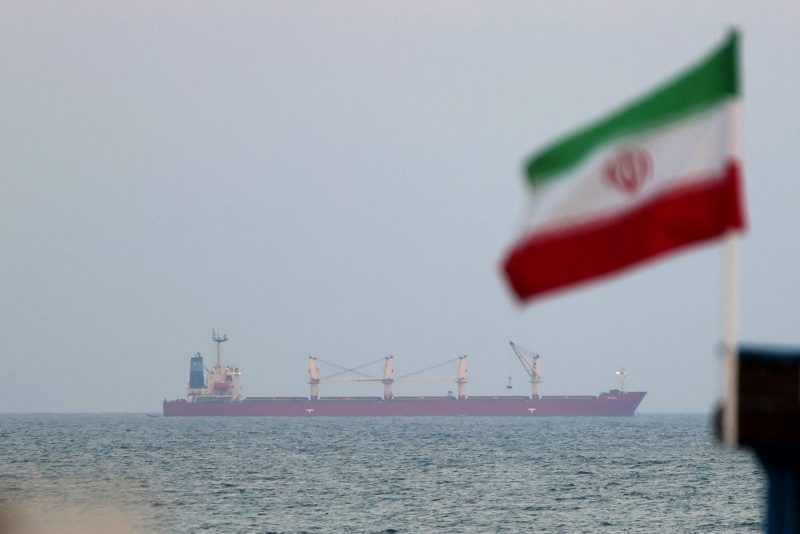
As the war against Iran enters a new phase, the chances are you may have heard the term “shadow fleets.”
Shadow fleets have operated for decades. But the world now is waking up to these illicit and dangerous shipping operations. They’re also known as “ghost ships,” and “dark fleets.”
As their name suggests, these are dangerous vessels that carry illicit drugs, money and weapons, including major weapon systems, as well as cheap oil.
It’s the cheap oil that encouraged the U.S. to block the Strait of Hormuz. But it also puts a dent into a vast armada of illicit shipping led by the Islamic regime in Tehran.
Many of these ghost ships, often internationally sanctioned vessels, originate from Iran. Now, Washington is specifically targeting these ships to starve Iran’s economy.
The Iranians ship their below-priced oil to a zone off the coast of Malaysia where they off-load the petroleum to other ships that deliver their oil to Chinese ports.
Iran is one of the biggest operators of these illicit vessels. But they’re not alone. They’re joined by a sophisticated underground system that’s been overseen by the world’s worst regimes including Russia, North Korea and until the arrest of Nicholas Maduro, by Venezuela.
The ghost ships are vessels – mostly carrying oil – that intentionally turn off their Automatic Identification System (AIS) transponder to avoid detection. This is known as “going dark.”
The ships try to hide their location, identity and their illegal products.
Other vessels that try to evade detection involve “spoofing” in which a captain broadcasts false AIS signals. This practice allows the captain to tell maritime authorities that they are in a different location.
According to the nonprofit organization, United Against Nuclear Iran, (UANI), “Since the start of the conflict, UANI has observed at least 26 ghost fleet tankers laden with Iranian oil that have left the Persian Gulf — some broadcasting their AIS signals and others operating clandestinely. These tankers are enroute to Malaysia to conduct ship-to-ship (STS) transfers with other ghost fleet vessels bound for China.”
The existence of a dark fleet illegally transporting cheap oil to China drew public attention a few days ago when we learned that the US military had intercepted at least three Iranian-flagged tankers in Asian waters. The U.S. Navy redirected them away from their positions near India, Malaysia and Sri Lanka – thus denying the Chinese inexpensive oil.
Of course, for the Trump administration, this is a double win. They deny revenues to the Mullahs and block cheap oil to the Chinese.
The practice of ghost ships has been around for decades, and for the most part, the world has mostly tut-tutted about them. It first received some attention when the war in Ukraine began, and Russia relied on ghost ships to transport its sanctioned oil.
The first inkling that ghost ships were operating in our own hemisphere became known last January when the U.S. Coast Guard and Navy seized a ship named Bella1.
The so-called Bella1 originated from Venezuela, tried to evade U.S. Naval ships by changing its name to Marinera and then changed its flag status from a false Guyanese registration to Russian flagging.
The interdiction of the Bella1 was part of a larger effort to deny Venezuelan narco-drug criminals and to block the Hezbollah terrorist organization which openly operated in the country, particularly on the island of Margarita which once was solely considered a vacation destination.
Guns, money, illicit drugs and young girls have been part of the Venezuelan operations. And of course, the Venezuelans also were eager to offer cheap oil to their Chinese allies. It all operated in our back yard in the Caribbean.
Last December, the United Nations denounced the U.S. interception of the ghost ships carrying illicit Venezuelan oil.
Defending the operation of the ghost ships, the UN Office of High Commissioner righteously huffed and puffed that the U.S. had “no right to enforce unilateral sanctions through a blockade.” The U.S., appropriately, ignored the United Nations and boarded ghost ships that carried the illicit cargoes.
Now for the first time with Operation Epic Fury, the Trump administration is beginning to expose to a larger public the illicit global “high value” of these shadowy armadas.
Earlier this week the world got a peek into it when the U.S. Navy outside of the Straits of Hormuz interdicted and boarded the M/F Tifania, a “stateless sanctioned” vessel. The U.S. Indo-Pacific Command intercepted and took over the Tifania.
The Tifani, wasn’t only a stateless crude oil tanker, but it was previously sanctioned by the U.S. State Department for facilitating the transfer of illicit Iranian oil between ships.
The Department of War, in a post on X, stated, “As we have made clear, we will pursue global maritime enforcement efforts to disrupt illicit networks and interdict sanctioned vessels providing material support to Iran—anywhere they operate. International waters are not a refuge for sanctioned vessels. The Department of War will continue to deny illicit actors and their vessels freedom of maneuver in the maritime domain.”
The exposure of the Iranians in the illegal shipping business also is quite instructive about the Iranian terror families behind them.
The Iranian oil-shipping magnate is Mohammad Hossein Shamkhani who is the kingpin of the Iranian ghost fleet.
Mohammad he is the son of the now-deceased senior Iranian official Ali Shamkhani.
Ali Shamkhani was the secretary of Iran’s Defense Council and close adviser to Supreme Leader Ayatollah Ali Khamenei. He was killed in the first Israeli and US strikes on Iran at the beginning of the war.
So, the son carries on the crime family’s activities led by the father.
Now, the Trump administration’s war against the Shamkhani crime family has extended from the U.S. military to the U.S. Treasury Department.
On April 15, Treasury sanctioned the Shamkhani family and other Iranians involved in the ghost armada. This program is called “Economic Fury,” a spin-off of Operation Epic Fury.
Treasury Secretary Scott Bessent directed his Office of Foreign Assets Control (OFAC) to sanction “more than two dozen individuals, companies, and vessels operating within the network of Iranian oil-shipping magnate Mohammad Hossein Shamkhani.”
Bessent said, “OFAC has severely intensified sanctions against Iran’s shipping industry under ‘Economic Fury’ initiatives, targeting a ‘shadow fleet’ of tankers, front companies, and individuals enabling illicit oil and weapons transport. These actions, targeting networks like that of Mohammad Hossein Shamkhani, block assets and impose secondary sanctions on international entities—including firms in the UAE, India, and Marshall Islands—that support Iran’s energy sales and military procurement,” according to the Department.
Still, it appears that the ghost ships are still operating with impunity in the South Pacific. These ships are in a staging area in a region known as the Eastern Outer Port Limits (EOPL) anchorage area, located off the coast of Johor, Malaysia. Virtually all are destined to deliver oil to China.
As UANI noted, “On April 1, 34 tankers listed on UANI’s Ghost Armada were anchored or loitering in the EOPL area with their AIS signals active. Despite the ongoing conflict, it is business as usual for the Iranian oil trade to China, where ghost fleet tankers continue to operate with impunity across Southeast Asia’s sea lanes.”
The battle against the ghost ships will continue and most likely the Pacific campaign will continue to be operational even if the war with Iran somehow is settled.
Maybe, the war in Iran may put an end to the Mullah’s dictatorial regime. But it may also provide some lasting damage to this dark fleet.
(Views expressed by guest commentators may not reflect the views of OAN or its affiliates.)
Richard Pollock is a former New Left activist and was a roommate with Chicago 7 defendant Rennie Davis. He understands New Left strategy and tactics. For four decades, Richard was an investigative reporter based in Washington, D.C. Among his positions, he served as the senior investigative reporter for the Washington Examiner, the Daily Caller News Foundation, and at OAN. While at OAN he served in the Washington, D.C. bureau and hosted its investigative reporting specials. He is semi-retired and his posts from D.C. can be read on Substack.com
What do YOU think? Click here to jump to the comments!
Sponsored Content Below