

OAN Staff Katherine Mosack
3:20 PM – Wednesday, September 30, 2026
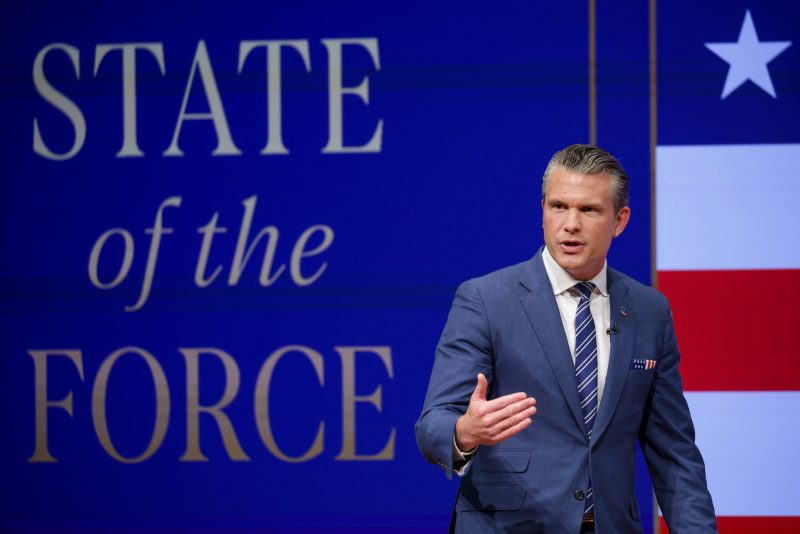
U.S. Secretary of War Pete Hegseth laid out his vision for combat readiness, physical standards and a better streamlined leadership structure in the United States military during his “State of the Force” address, an annual speech to establish strategic priorities, standards and reforms for the armed forces.
At Marine Corps Base Quantico on Wednesday, Hegseth delivered a 50-minute speech to non-commissioned officers (NCOs) and captains, unveiling six major strategic initiatives that will govern the Department of War.
The secretary hailed the establishment of the Autonomous Warfare Command (AutoWarCom), which is set to begin operations by October 1, 2027, led by Owen West, the current Director of the Defense Innovation Unit (DIU), a War Department organization that aims to help the U.S. military make faster use of emerging commercial technologies.
The command will be a new four-star combatant command that will use autonomous and semiautonomous systems to combat threats, based on the success of the department’s Drone Dominance program.
“Drone warfare supercharged by AI-enabled targeting is the biggest battlefield revolution in generations,” Hegseth remarked.
Hegseth touched on America’s Corps of Cadets, a new success of the department’s Drone Dominance program meant to lead more “patriotic leaders of character” to military service.
This initiative partners with Distinguished Military Colleges including Louisiana State University, Liberty University, Tuskegee University, Mississippi State University and Hillsdale College, which already require “exceptionally high standards of cadet discipline, tactical instruction and military organization.”
He also announced Federal Operations for Resilience, Troop Resources, Energy, Supply, and Survivability (FORTRESS) America, which the department described as its “national insurance policy” for the homeland.
“The initiative ensures that every major U.S. military installation generates its own independent power so bases remain lit, aircraft fly, and command centers stay online even if the civilian grid is taken down by cyberattack or sabotage,” the War Department explained in a press release. “It brings critical supply chains home—rare earths, specialty metals, semiconductors, and propellants—mined, refined, and built in America by American workers.”
“We are not looking for a war, but we will be prepared if one comes,” the secretary stated. “We will make certain that America cannot be starved out, shut down or cut off.”
Additionally, Hegseth remarked upon the Next Great American Base project establishing a new joint military installation in the U.S., which will feature independent power generation, autonomous systems and advanced air defenses.
“When we bring those troops home, we don’t just reshuffle troops into legacy posts. We will build them beautiful new bases from the ground up,” Hegseth said, later adding, “We have not built a new base in this country in 40 years. That ends now.”
“Our troops will have clean, first-class barracks, world-class training facilities and thriving communities,” he stated. “We owe our warriors nothing less.”
The secretary established the Office of Religious Affairs (ORA) to “strengthen religious support” within the military.
The department clarified that Service chaplaincies will remain the providers of religious support and that the ORA will give them “a powerful advocate at the highest level of the Department” with a “direct line to the secretary.”
Finally, Project Meridian, partially led by Tesla CEO Elon Musk, is intended to “examine the full spectrum of future warfighting domains” to “secure America’s long-term military superiority,” the War Department said.
“We need to be looking forward to the future to achieve technological and military dominance on the battlefield,” said Hegseth.
He projected the project to be completed within 120 days of his address, culminating in fully public reports containing experts’ findings and recommendations for the future of warfare.
Stay informed! Receive breaking news alerts directly to your inbox for free. Subscribe here. https://www.oann.com/alerts
What do YOU think? Click here to jump to the comments!
Sponsored Content Below