

Commentary by: Peter McIlvenna
Thursday, September 24, 2026
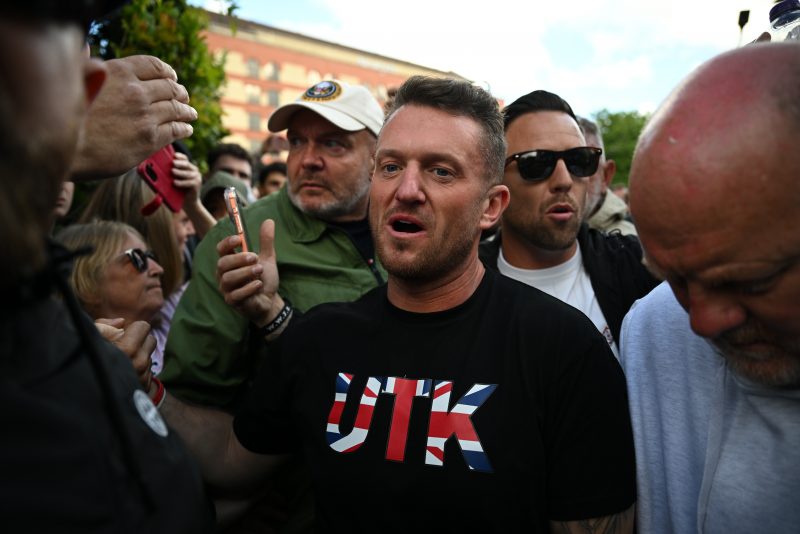
Tommy was detained at a UK airport yesterday by counter-terrorism police on the basis of Schedule 3 of the Counter-Terrorism and Border Security Act. He was kept for questioning regarding his views on Russia, his phones were taken, and he was let go without being charged.
This is the fourth instance of police officers using those powers against him—not in connection with a crime, but to access his devices and question him about his lawful opinions.
Tommy is one of Britain’s best-known political activists, and his Unite the Kingdom rally last September attracted at least one million people. I was positioned near the stage and witnessed the huge crowd, together with the drone footage, which was visible to everyone.
Elon Musk uploaded the stream to his X page and the following day about forty million people had viewed it, making the event one of the most-watched of the year.
It was his work on grooming gangs that made him a target, since his book and film Silenced placed him directly at odds with the institutions which had for decades ignored the problem. The official findings are serious. The Jay Report discovered that 1,400 children had been abused in Rotherham between 1997 and 2013.
Baroness Casey’s review stated that the police and local councils deliberately avoided mentioning the ethnic background and religion of the people who had committed the abuses for fear of being accused of racism. The Independent Office of Police Complaints (IOPC) later described the South Yorkshire Police’s failure as a systemic organisational failure – a cover-up in all but name.
Therefore, victims do have a rational reason to fear that whenever they see Tommy being stopped under these powers. If they provide him with evidence, will it reach the same police forces that ignored them for decades? This is what is known as the chilling effect, and it seems less like mere airport security and more like an attempt to cut him off from the people who could confirm his claims.
Who gave the go-ahead? Although Schedule 3 allows an examining officer to stop and question a person at a port without any suspicion, officers still have to be accredited by their Chief Officer to the national standard.
A senior officer of higher rank, who was not part of the questioning, must carry out the search. It wouldn’t be for a low-level constable to decide on targeting a man like Tommy four times. Someone in a higher position would have to approve the pattern.
The Attorney General’s Office has taken a direct role in this matter. In 2024, Solicitor General Sarah Sackman filed two contempt applications against Tommy over the film Silenced, which was shown at a rally in Trafalgar Square in central London; as a result, he was sentenced to eighteen months’ jail.
The government is not merely watching this situation — it has been in the courtrooms and is now present at the airport terminal.
Schedule 3 was introduced to deal with hostile state activity—such as espionage, sabotage, cyber attacks, or serious crime carried out for or on behalf of a foreign government. It was never intended to be used for repeatedly detaining a domestic journalist who criticises the government’s policy on Russia, immigration, or grooming gangs.
When the bill was passed by Parliament, there was only limited discussion regarding safeguards for journalists. Although the code includes provisions to protect confidential material, the power it grants is so broad that a single officer can decide a person is worth investigating.
In the United States, Customs and Border Protection can search electronic devices at the border without obtaining a warrant; in the financial year 2025, they carried out more than fifty-five thousand such searches.
Journalists have raised concerns regarding the effect on source protection, but the UK’s Schedule 3 goes even further by permitting detention, compulsory questioning, and multiple applications against the same person without any criminal threshold.
The UK government has, for the fourth time, labeled Tommy as a terrorist. That is not true; he is a journalist who covers issues which the establishment would prefer to ignore.
The real issue is why a democracy should have terrorism laws in order to silence a man who has exposed what he views as the biggest cover-up in recent British history — the targeting and rape of up to one million White English girls by gangs of Muslim Pakistani men for six decades.
(Views expressed by guest commentators may not reflect the views of OAN or its affiliates.)
Peter McIlvenna is a British cultural commentator, Christian advocate, and host of Hearts of Oak. He was National Campaign Manager for the UK Independence Party and is Chief of Staff to Lord Pearson in the House of Lords. He speaks on free speech, Christian values, and Islamisation of the West, and is a fellow of the Institute for the American Future and American Freedom Alliance.
What do YOU think? Click here to jump to the comments!
Sponsored Content Below